


5 Benefits of Wide Wood Plank Flooring for Modern Homes
May 8, 2026
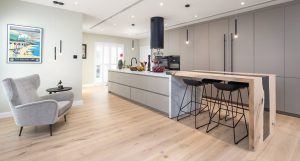
Wider oak boards help extend the sense of openness throughout this light-filled Green Community residence.
The scale of a floor changes the way a room is experienced. Fewer seams create a calmer visual flow, allowing spaces to feel more open, connected, and architecturally balanced. In contemporary interiors, wide plank wood flooring has become closely associated with a more restrained design language, where materials are expected to bring warmth, texture, and continuity without overwhelming the space.
Understanding how wider boards influence proportion, material expression, and spatial flow is key to specifying them successfully within a modern spaces.
What Defines Wide Plank Wood Flooring?
Plank width is typically measured in millimetres. Standard strip flooring generally falls below 90mm, while medium-width boards range between 90mm and 140mm. Wide plank wood flooring usually begins at 150mm and can extend beyond 300mm in premium engineered wood flooring formats.
The difference extends beyond appearance alone. Wider boards cover more surface area per piece, reducing the number of joins across the floor. This creates a more continuous appearance, where the material reads with greater clarity and less repetition.
That sense of cohesion is one reason broader board formats have become closely associated with modern and Scandinavian-inspired residences. Both approaches favour simplicity, natural materials, and visual restraint. A larger-format board supports that language more naturally than a tightly segmented floor pattern.
Wide Plank vs Narrow Plank Flooring
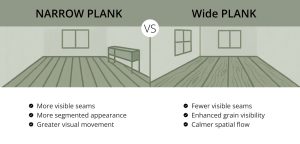
A floor with smaller boards creates a denser pattern across the surface, introducing more movement and visual detail throughout the room. This effect is typically associated with narrow plank flooring, which often suits traditional spaces with more decorative architectural elements.
Wide plank flooring produces a different effect. Broader boards create a calmer, more unified surface that allows the eye to move more naturally through the room. In open-plan spaces especially, where living, dining, and kitchen areas connect visually, this continuity helps reinforce the overall flow of the layout.
Neither format is inherently better. The appropriate choice depends on the proportions of the room, the character of the interior, and the role the floor is expected to play within the wider architectural composition.
The benefits of expanded plank widths extend beyond appearance, influencing how a space feels, functions, and performs over time.
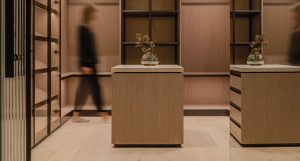
Limetree Valley Villa Jumeirah Golf Estates wide wood flooring creating a seamless flow throughout the dressing space.
1. Wide Wood Plank Flooring Creates Stronger Visual Continuity
One of the most immediate effects of wide plank flooring is the sense of continuity it creates across a room. Fewer joints allow the surface to read more cohesively, reducing visual interruption and giving the floor a calmer, more unified presence.
In open-plan villas and contemporary apartments, this becomes particularly important. Living, dining, and circulation areas often share the same flooring, and excessive segmentation can disrupt the architectural flow the layout is intended to create. Broader boards help preserve that connection.
This consistency influences several aspects of the space:
- Fewer seams across the surface
- Smoother visual flow between spaces
- More even distribution of natural light
- Reduced areas for dust and debris to collect
In larger homes especially, the effect becomes immediately noticeable once full-length samples are viewed within larger residential interiors.
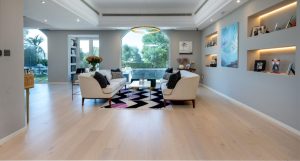
Wide Oak Nouveau Blonde flooring creating a calmer visual flow throughout this Esmeralda Villa in Victory Heights.
2. Wider Boards Showcase the Natural Character of Wood
Natural wood carries variation by nature. Grain movement, tonal shifts, knots, and surface texture differ from board to board, giving the material a depth that manufactured surfaces rarely replicate convincingly.
Wider boards allow those details to be read more clearly. A 200mm oak plank reveals considerably more natural variation than a narrow strip of the same species. Grain becomes more legible, while tonal movement feels layered rather than visually busy. Brushed and naturally oiled finishes enhance this further, emphasising texture instead of concealing it beneath heavier treatments.
This is one reason wider oak boards are closely associated with Scandinavian and Japandi-inspired homes, where materials are expected to provide visual interest without excessive pattern or decoration.
The effect becomes especially noticeable through finish selection:
- Pale tones reflect more natural light and create a lighter atmosphere
- Ultra-matt finishes soften reflection and emphasise texture
- Darker finishes introduce warmth and depth without heaviness
In each case, the width of the board allows the material to retain its visual character across the room.
3. Wide Plank Wood Flooring Supports Contemporary Interior Design
Contemporary residential settings often rely on restraint rather than decoration. Neutral palettes, natural materials, open layouts, and large-format furniture create spaces where continuity matters more than ornament. Wide plank flooring fits naturally within that language.
Broader boards create a quieter architectural foundation and allow other elements in the room to read more clearly. Where narrow strips introduce more movement across the floor, larger boards support the interior without dominating it.
This is particularly relevant in minimalist villas and contemporary penthouses, where the relationship between floor, wall, and ceiling shapes much of the spatial experience.
These larger boards also adapt well to architectural spaces that evolve over time:
- Restrained surfaces remain visually relevant for longer
- Natural wood works across changing furniture styles and palettes
- Simpler floor patterns provide greater flexibility as interiors change
This longevity is part of what gives expanded plank widths their lasting appeal in modern residential design.
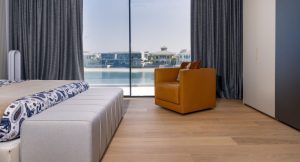
In this Palm Jumeirah residence, broad oak boards balance natural light with a calmer material palette.
4. Engineered Wide Plank Flooring Offers Greater Stability
Solid wood responds naturally to changes in humidity and temperature, expanding and contracting as conditions shift. Across broader boards, that movement becomes more noticeable, increasing the risk of gaps, cupping, or warping if installation conditions are not properly controlled.
Engineered wide plank flooring addresses this through its layered construction. A hardwood wear layer is bonded to a stable timber core, reducing dimensional movement and improving long-term consistency. This makes larger boards more reliable in open-plan interiors and homes where indoor conditions fluctuate throughout the year.
Because expanded plank widths expose imperfections more easily, installation quality becomes especially important:
- Uneven subfloors are more noticeable across wider surfaces
- Proper acclimatisation helps minimise movement after installation
- Glue-down installation often provides greater long-term stability
- Layout planning influences visual balance across open spaces
These are not drawbacks of broader flooring formats. They are considerations that reinforce the importance of proper specification and installation precision.
5. Wide Wood Plank Flooring Offers Long-Term Design Longevity
Wide plank flooring carries a long-term advantage beyond appearance alone: it tends to age well. Restrained surfaces generally remain relevant longer than trend-led patterns, particularly in spaces expected to evolve over time.
Natural wood adapts more easily to changing furniture, palettes, and decorative styles, allowing the floor to remain visually consistent even as the home changes around it.
This longevity is supported by several practical factors:
- Engineered boards with sufficient wear layers can often be refinished
- Simpler floor patterns age more consistently over time
- Natural materials remain adaptable across changing design styles
- proper maintenance helps preserve the finish and surface quality for longer
A floor that can be restored rather than replaced represents a more durable and considered approach to residential materials over time . This longer lifecycle is one reason wood flooring is often viewed as an investment that pays off in the long run.
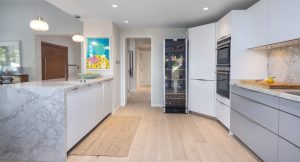
Within this Zulal Villa, broad oak boards introduce warmth and visual balance to the modern kitchen layout.
What to Consider Before Choosing Wide Plank Wood Flooring
Wide plank flooring performs best when the proportions, finish, and layout direction are considered in relation to the space itself. Width alone does not determine whether a floor will feel balanced once installed.
Matching Plank Width to Room Scale
Very wide boards can feel disproportionate in compact rooms. A 240mm plank may suit an open-plan living area comfortably, yet feel visually heavy within a narrow hallway or smaller room. Ceiling height, natural light, and room proportions all influence how the floor is perceived.
Broader planks tend to work more comfortably in larger layouts, but there is no fixed formula. The objective is not simply to maximise board width, but to achieve visual balance across the space.
Choosing the Right Finish for Natural Light Conditions
Finish selection influences how the flooring interacts with light throughout the room:
- lighter tones increase openness and reflect natural light more evenly
- ultra-matt finishes soften reflection and create a calmer surface appearance
- darker stains introduce warmth and depth, but generally benefit from stronger natural light
Assessing samples within the actual interior remains more reliable than viewing materials in isolation, particularly when light conditions vary throughout the day.
Wide Plank Flooring as a Long-Term Architectural Decision
The effect of wider boards extends beyond appearance alone. Fewer joins create a more cohesive visual flow, while broader planks allow the inherent character of the timber to remain more visible throughout the space. Combined with the stability of engineered construction, these qualities support a floor that remains both functional and visually relevant over time.
The strongest results come from treating the floor as part of the architecture rather than a decorative surface applied afterwards. When proportion, material selection, finish, and installation quality are considered together, wide plank flooring becomes a lasting part of how the home is experienced.
Key Takeaways
- Wider boards reduce visual fragmentation, helping interiors feel calmer, more open, and more cohesive.
- Wide plank wood flooring allows the natural grain and texture of the material to become more visible and expressive.
- Long-term performance depends on balancing material quality, room proportion, and installation precision together.

Warm Regards,
Pauline Madani
Founder & Managing Director Nordic Homeworx
Frequently Asked Questions
Do wider boards make a small room feel larger?
▼In many cases, yes. Wide plank flooring reduces the number of visible joins across the surface, creating a more unified visual rhythm. This can help compact rooms feel more open visually, particularly when paired with lighter finishes and consistent layout direction.
What is the best wood species for wide plank flooring?
▼Oak is one of the most widely used species for wide plank flooring because of its stability, grain definition, and versatility across different interior styles. Its organic variation also becomes more visually expressive in broader formats.
Are broader boards more expensive than standard formats?
▼Wider boards are often more expensive due to the larger material yield, board dimensions, and installation precision required. Many homeowners, however, view wide plank flooring as a longer-term investment because of its durability and timeless appearance.
Can wide plank flooring be installed over underfloor heating?
▼Yes, engineered wide plank flooring is generally suitable for underfloor heating systems when specified correctly. Engineered construction responds more predictably to temperature changes than solid wood, making it a more stable option in these environments.
How wide is too wide for a wood floor?
▼The appropriate width depends on the proportions of the room, ceiling height, and overall layout. Very broad planks can feel visually heavy in compact spaces, while larger open-plan interiors tend to accommodate wider boards more naturally.